
Categories

The end of easy growth in smartphones

At the end of last year I was saying that the smartphone boom was a tide that lifted all boats. That is no longer the case.
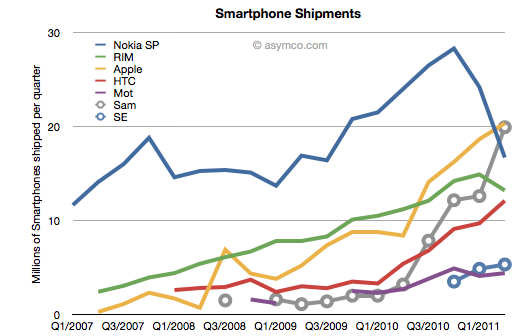
 

But the big story is that there has been a clear non-seasonal counter-cyclical decline in Nokia and RIM’s smartphone performance. RIM’s steady rise has come to an abrupt halt. Nokia’s decline has accelerate precipitously. So much so that Samsung and Apple have overtaken Nokia and RIM and it looks like HTC will overtake RIM within one quarter and perhaps Nokia as well.

The fortunes of vendors is now clearly tied to the fortunes of their platform choices. Android has a spotty record with Samsung[1] and HTC having accelerated growth with Android, Motorola and Sony Ericsson have not rallied to a similar degree (though they did remain operational). But it’s at least very clear that BlackBerry OS and Symbian are now a burden to their owners.

The fact that not all vendors benefit from a boom indicates that the early, happy days are over. People are noticing that there is a difference between smartphones and are not buying any and all. An era of competition will follow. I hinted that such a shift would happen when a “tipping point” was forecast and that point has been reached in several mature markets.

The consequences are that weaker platforms and vendors will come under increasing pressure.

Notes:

  1. Samsung decided to stop reporting the number of smartphones they sell. They also refuse to report the break-down between different platforms–they sell Windows Phone, Bada and Android devices. The figure I gave to Samsung is 19.9 million units, higher than 19.0 and 19.3 million from other analysts.
  • Pingback: The Smartphone Salad Days Are Over | Information Technology Leader

  • Eoulim

    As far as I know, samsung's recent rise has been mainly due to Galaxy S. This phone has not arrived in US. Next quarter will be about iPhone 5 vs galaxy s ! The battle will distance others further away from apple and samsung.

  • http://www.socialmotus.com SocialMotus

    Interest to read "The end of easy growth in smartphones" , i agree that weaker platforms and vendors will come under increasing pressure.

  • http://twitter.com/WaltFrench @WaltFrench

    Google and Apple HAD an excellent working relationship all right. But despite the explosive growth rates, nobody can take anything, especially your profits versus another's, for granted— you end up like RIM. I think Google was absolutely right that if Apple got to > 50% share of mobile internet, Apple would have significantly re-negotiated their terms.

    And even if Jobs decided he wanted to compete for the Nicest Guy in the Valley Award, the risk that another firm (Microsoft, RIM, it hardly matters) would leapfrog Apple and compete on profitability of search, Google could've found itself reduced to being some vendor's in-house ad server, squeezed to no profits at all.

    Horace has opined that Google has precluded business opportunities by emphasizing Android, and that surely is right. But Google has also protected itself from being marginalized with Android.

  • n13l5

    quoting from your text:
    "But it’s at least very clear that BlackBerry OS and Symbian are now a burden to their owners."
    I'm not so sure that that's "clear" from these charts.

    I'd really like to buy a top specced phone with MeGoo, but there isn't one.
    I might have bought Apple if their hardware specs weren't behind.
    I would have preferred to buy Sony, if their hardware specs weren't behind.
    I looked at Rim phones and found their hardware to be behind.
    I really didn't want to buy Samsung, but their hardware was top notch.

    I figure Samsung picks up all the buyers who care about specs and those influenced by spec focused buyers like me, or those who want/need a specific feature, like 1080p video or Amoled screens.

    Like with computers, when the operating system is commoditized, you buy the best hardware you can get.