
Categories

iTunes now costs $1.3 billion/yr to run

The iTunes store continues to grow. The data that Apple published in the last event included the following:

  • 15 Billion iTunes song downloads
  • 130 million book downloads
  • 14 billion app downloads
  • $2.5 billion paid to developers
  • 225 million accounts
  • 425k apps
  • 90k iPad apps
  • 100k game and entertainment titles
  • 50 million game center accounts

As this data is added to the existing data and cross-referenced additional insight into the economics of iTunes is emerging.

Since we know something about the average price of songs and apps, and we know the split between developers and Apple (and roughly between music labels and Apple) we can get a rough estimate of the amount Apple retains to run its store.

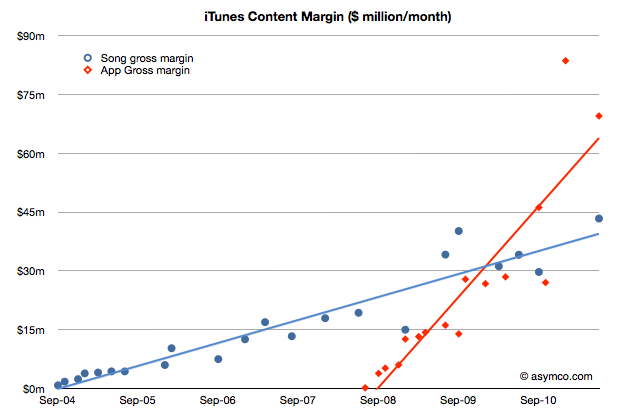
The following chart shows iTunes “content margin” by month. This margin is what Apple “keeps” after paying content owners but before paying for other costs like payment processing and delivery/fulfillment which should be accounted as variable costs. Strictly speaking this margin is not “gross margin”.
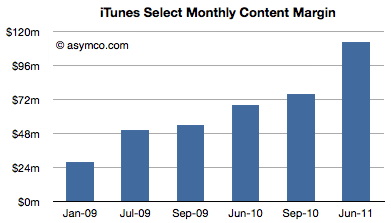
If we add the content margins from music and apps and assume the store runs at break even we can get an idea of what it costs to operate the store.  The latest number is $113 million per month (from a total income of $313 million/mo.). It implies over $1.3 billion per year.
Much of that cost does go into serving the content (traffic and payment processing). Some of it goes to curation and support. But it’s very likely that there is much left over to be invested in capacity increases.

I would like to hear alternative opinions, but my guess is that much of the capex that went into the new data centers Apple built came from the iTunes operating margin.

  • http://twitter.com/e_orione @e_orione

    Why do you assume that the store is running at break even?

    • http://twitter.com/andreionut @andreionut

      The apple execs are always saying that. http://allthingsd.com/20100225/apple-billions-of-

      • http://twitter.com/e_orione @e_orione

        Ok, this is from your link, written February 2010:
        "[Apple CFO] Peter Oppenheimer
        …Regarding the App Store and the iTunes stores, we are running those a bit over break even and that hasn’t changed. We are very excited to be providing our developers with a fabulous opportunity and we think that is helping us a lot with the iPhone and the iPod touch platform.
        As Oppenheimer says, this isn’t a new development. Apple (AAPL) has always maintained that iTunes wasn’t a real money maker. It’s supposed to help sell iPods, iPhones, and soon, iPads.
        For years, industry observers figured that as the iTunes business scaled, this would change. An alternate theory, held by some of Apple’s media partners–the company was being overly modest about its success."
        I am with the industry observers, iTunes business has scaled, it is no more just above break heaven.
        Operational cost could not increase with same rate of income, it should increase more as a ladder.

    • David V.

      It's probably an approximation based on Tim Cook's repeated assertion (during quaterly conference calls) that the iTunes store operates slightly above break-even mode.

  • Ondrej

    Related to this, there's an interesting source of cash not discussed very often: Apple pays both developers and labels (or other right owners) in specified intervals, so they hold onto the customer payments in the meantime. While that amount might not be that interesting compared to their cash at hand from their income, it is still something worth looking into, because as any other money source, it can be further invested or otherwise used.

    • Walter.French@FAFAdvisors.Com French

      Apple is known for extremely conservative investments overall so “escrowed” monies probably sit in extremely low interest rate money market funds

    • http://twitter.com/danielaxelsen @danielaxelsen

      Yeah, Walter's right, but also – lump payments have more to do with transaction costs, which can be huge percentage-wise for micro transactions. The float here is not really relevant compared to Apple's ~$60Bn in cash.

  • Eas

    @ondreij, that float works both ways. Apple doesn’t bill customers immediately because they try and bundle multiple iTunes transactions into a single credit card transaction to keep processing fees down.

  • newtonrj

    Datacenters such as Maiden, NC are long term CapEx projects of 3-5yrs. Funding is usually forecasted against operating margin to a capital expenditure portfolio project.

    Additionally, my assumption is that Maiden is not simply a stand-alone data center but also has failover capacity elsewhere. Losing Maiden shouldn't mean a loss to iCloud. -RJ

  • Pingback: $1.3 Billion: Annual Cost Of Running iTunes | StatSpotting!

  • Stefan Youngs

    It's very much to Horace Dediu's credit that comments on his articles demonstrate a quality of intelligence and perception and seem to be devoid of the shrill bias that passes for comment on many other blogs and articles. Good job Mr. Dediu and your contributors. May it long continue.

    • http://ozechad.wordpress.com ozechad

      Well said. One only has to listen to Episode 1 of The Critcal Path to understand why!

  • http://twitter.com/fizzard @fizzard
    • huxley

      Probably not much, I've seen articles that claim that as few as 70% of gift cards are ever reimbursed. Working on the assumption that reimbursement rates at the macro-scale can be estimated, you can avoid eating into your margin, even if the cards are discounted at less than face-value.

  • Childermass

    I wonder if Tim Cook was referring to 'a bit over break-even' as a model or as the current state of affairs. If it was the model then Apple would have had to ramp up expenditure to avoid earning a better return as the more recent history is at a better margin. If it was as it was (continued below)

  • Ziad Fazel

    Fine work again, Horace. Bit of clarification needed, because it appears you are mixing two kinds of analysis.

    For an Income Statement kind of analysis based on "break-even", the accumulation of "content margin" – aka profit contribution by product line – for a capital investment would not appear. Capital investment is an application or sink of cash which does not appear on the Income Statement, just its depreciation and amortization, which does not kick in until the new investment starts generating revenue.

    For a Cash Flow kind of analysis, then definitely the accumulation of cash generated by the "content product line" or iTunes Store for capital investment would appear. Cash generated by the Operations section is applied into the Investments section, regardless of whether the investment has been put into use yet.

    So when CFO Oppenheimer says the iTunes Store is operating around break-even, he is likely talking on an income statement basis, against the depreciation and amortization of the iTunes Store, not its cash flow, which may be very heavily negative during times like these of heavy investment.

    People might take him out of context as "iTunes lost $4 billion last year!!!" when that may just be the cash flow from investment, on which we expect Apple to earn its usual wonderful returns.

    • Childermass

      CapEx. First, we would need to know what else the new facility does. If it is solely to service the iTunes store then its depreciation will go there, but maybe it has many uses. Second, we need to know Apple's policy on depreciation. They seem like the kind of cautious business that would like to write it off as fast as possible.

      • Ziad Fazel

        Childermass, we can find that information in Apple's financial statements, segmented by Apple's geographical basis in some cases: policy on depreciation, amount of depreciation in each period, amount of capital investment in each period, and gross and net asset values after depreciation and amortization.
        http://www.sec.gov/Archives/edgar/data/320193/000

        However I think that you are making the same mistake as Horace by deducting the capital investment in each period from the revenues. There is a delay between when the investment is being made, and recorded on the cash flow statement, and when its value is depleted over its useful economic life, as depreciation in income statement for years to follow the investment.

        Apple is very much in an investing and growth period, which it describes repeatedly in its financial statements. It has been investing in PPE at more than twice the amount of annual depreciation, for 2010, 2009 and 2008. See also Note 4 on page 66 which shows the gross PPE at end 2010 as $7.2b with a net $4.8b still to be depreciated or amortized.

        [p49] "Payments for acquisition of property, plant and equipment (2,005) (1,144) (1,091)

        [p56] " Property, Plant and Equipment

        Property, plant and equipment are stated at cost. Depreciation is computed by use of the straight-line method over the estimated useful lives of the assets, which for buildings is the lesser of 30 years or the remaining life of the underlying building, up to five years for equipment, and the shorter of lease terms or ten years for leasehold improvements. The Company capitalizes eligible costs to acquire or develop internal-use software that are incurred subsequent to the preliminary project stage. Capitalized costs related to internal-use software are amortized using the straight-line method over the estimated useful lives of the assets, which range from three to five years. Depreciation and amortization expense on property and equipment was $815 million, $606 million and $387 million during 2010, 2009 and 2008, respectively.

        Long-Lived Assets Including Goodwill and Other Acquired Intangible Assets

        The Company reviews property, plant and equipment and certain identifiable intangibles, excluding goodwill, for impairment. Long-lived assets are reviewed for impairment whenever events or changes in circumstances indicate the carrying amount of an asset may not be recoverable. Recoverability of these assets is measured by comparison of their carrying amounts to future undiscounted cash flows the assets are expected to generate. If property, plant and equipment and certain identifiable intangibles are considered to be impaired, the impairment to be recognized equals the amount by which the carrying value of the assets exceeds its fair market value. The Company did not record any significant impairments during 2010, 2009 and 2008."

      • Childermass

        Thank you.

        I do not think I have suggested deducting capex from revenues, rather I was asking, firstly, what proportion of the new centre is allocatable to iTunes and, secondly, how aggressively Apple will write the asset down? All of it or some of it? Three years, or five? For the iTunes P&L the differences could be large.

        We are working in a bit of a fog, but the end game is to find out how profitable iTunes is.

      • Ziad Fazel

        Enjoying our conversation, Childermass.

        The new centre would not be a single asset. It would be composed of thousands of assets, all in different classes with their own depreciation rates: land, building, furniture, computers, capitalized software development, etc. Those rates are defined partly by IRS for taxes, and partly by the SEC for GAAP reporting, and Apple would have to be as consistent in their application for the assets in the new centre as for its existing business.

        We haven't seen the new centre in Apple's income statements yet, but it is part of the PPE line in the Cash Flow Investing section.

        How Apple allocates the depreciation, and overhead in general, to its different product lines will be interesting. Just off the top of my head, I would do it by throughput, allocating the costs of iCloud to the iOS and Mac divisions by volume of transactions with each device. Or maybe by revenue from iOS apps v OS X apps.

        Apple can run iTunes as a break-even because it generates its own sales for its content, like Amazon's formidable servers. So iTunes ability to drive more sales of Macs and iOS devices is pure gravy. Not like Microsoft's Online Services Division, whose massive perennial losses despite search ad revenue are very weakly justified (not at all to me) by stimulating or enhancing Windows or Office. Heaven forbid, if Apple pulled a Vista and Mac sales tanked for a couple of years, the iTunes Store would continue as a break-even. Without the cash from Windows and Office, Bing and most of Windows Live would burn up Microsoft's cash reserves until the board fired Ballmer and put the division out of its misery.

        I am sure Apple will segment the information from the new centre internally, and sift it 5 ways from Sunday to manage the business profitably. But like Google, Facebook, and Amazon, they won't share detailed information about the cost of their centres externally.

        Unlike iTunes, I think the new centre will be a large net expense, intended to drive sales of iOS and Mac devices. It may be divided as part of the P/L of those business units, and app sales may move from iTunes to the iCloud P/L. But yeah, we will be in a fog about that because Apple usually resists analyst questions about the profitability of particular product lines.

  • Childermass

    (continued) then the new business since then will have made a proper contribution.

    It is hard to imagine Apple deliberately increasing cost, or running a long-term break-even activity.

    Maybe looking at February 2010 as the real cost base for that level of business would allow us to estimate how profitable the business actually is eighteen months later.

    • http://twitter.com/Marcos_El_Malo @Marcos_El_Malo

      If the CFO said it in a conference call (and he has more than once), he's telling the truth under penalty of law. He'd be going to country club prison, but still prison, if he said anything fraudulent. If, at the next conference call he says something different, believe him. He has no reason to lie, and many reasons not to lie.

      • Childermass

        I think you have missed my point. The statements we are referring to were made nearly eighteen months ago. Maybe the business is more profittable now, as HD's graphs suggest.

      • Ziad Fazel

        Marcus, neither Childermass nor I is accusing the CFO of lying.

        My point is that by using the word "break-even" he is taking about an Income Statement, where you would see the depreciation on the assets as expense. Nothing misleading there.

        I believe Horace is improperly deducting a Cash Flow item – capital investment – from the iTunes revenues to reach the break-even. That is where the confusion is coming from.

  • Pingback: Report: iTunes costs $1.3 billon per year to run « Mac City

  • Pingback: likeithateitshareit » Report: iTunes costs $1.3 billon per year to run

  • Pingback: Report: iTunes costs $1.3 billon per year to run - Veletech

  • Pingback: Apple Spends $1.3 Billion A Year To Run iTunes And App Store (AAPL) | TechDiem.com

  • Tatil

    $1.3 billion is a lot to run a business at cost. I understand that it is part of en ecosystem, so it helps sell iPods, iPhones, iPads and maybe even some Macs, but then the gross margins in those business lines are misleading and it should include iTunes operations as part of their cost somehow.

  • Pingback: Apple Spends $1.3 Billion A Year To Run iTunes And App Store (AAPL) | Wordwide News Exposed

  • Eric D.

    If Apple is breaking even, then iTunes is a very good deal for them. They have sparked a renaissance in software development, an explosion in the use of apps. Because iTunes eliminates so many middlemen — manufacturers, retailers, DRM coders, packagers, traditional marketers — software is available to consumers at all-time low prices, even as more indie developers are thriving than ever before. The mobility and simplicity of use of the iOs line, combined with the lowered monetary threshold to delevelop and launch an app, has brought the power of computing into many new spheres of life. Even Apple is surprised at the success and growing ubiquity of the iPad.

    If Apple needs 1.3 billion dollars to maintain an environment where the efforts of developers are sheltered, then they a) attract more developers, which in turn b) expands their potential consumer and enterprise market and c) raises the bar very high for any competitors. So far, only Amazon and Google seem to have the financial and technical means to challenge Apple in this area. But it's just a loss-leader for Apple, since the bulk of their profits come from selling hardware. Actually, if it breaks even, it's not even a loss-leader.

    Maintaining the iCloud will no doubt be an order of magnitude higher in cost and complexity. But again, that means the competition has an even loftier bar to reach. Or to use Horace's military metaphor, a wider moat to bridge. The iCloud is going to be a big part of the solution for the millions of us who are overwhelmed by our ever-growing mountain of media and data. But Apple's solution also represents a huge economy of scale. By recognizing the titles in your iTunes library and matching them with virtual, high-fidelity avatars on-line, Apple eliminates at one stroke a tremendous potential for redundancy. Google and Amazon -must- follow this model, or they will be drowning in duplicated media files down the road.

    I like Apple's chances in this new battle zone. Thanks, Horace, for bringing some light into this new sphere.

  • Pingback: Report: iTunes costs $1.3 billon per year to run

  • Pingback: Apple’s iTunes Store, App Store now cost roughly $1.3 billion a year to operate | IT News Post

  • Pingback: Apple Spends $1.3 Billion Per Year To Run iTunes | HDSmokecig

  • http://www.carterdigital.com.au James Noble

    Wow, imagine how much it generates if it cost this much to run.

  • Pingback: Održavanje iTunesa košta 1,3 milijarde dolara godišnje | Netokracija

  • Pingback: iTunes kost Apple 1.3 miljard per jaar

  • Pingback: Mantener iTunes cuesta 1.300 millones de dólares al año | TICbeat

  • Pingback: iTunes Costs As Much As $1.3B To Run Yearly

  • Pingback: iTunes costs as much as $1.3B to run yearly | Rohan Sood's Blog

  • Pingback: Mantener iTunes cuesta 1.300 millones de dólares al año |

  • Pingback: Apple zahlt für iTunes Store 1,3 Milliarden im Jahr | PlayPhones

  • Joe

    I was wondering if the relationship between hardware sales and itune sales is discussed as well as the per sale margin for each?

  • Pingback: Anonymous

  • Pingback: Report: iTunes costs Apple $1.3 billion a year to run » MeetMeDaily.com

  • Pingback: $113 million per month to manage the iTunes Store

  • Pingback: iTunes Costs $1.3B to Operate Each Year (Estimated) - Technabob

  • Pingback: Mobile Lowdown 6-14-11: Lodsys; Ericsson/Telcordia; Skype/Comcast; iTunes | Market To Phones

  • Pingback: Report: iTunes costs $1.3 billon per year to run | Alternative downloads blog

  • Pingback: 每日观察:关注iTunes商店运营成本等消息(6.15) | GamerBoom.com 游戏邦

  • Pingback: iTunes costs Apple up to 1.3 Billion to run yearly | OddPattern

  • Pingback: Custos de manutenção do iTunes - Addicted2Apple

  • Pingback: Al Bar Sport | Script | iCreate

  • Pingback: Why Is Apple Negative in 2011? | MONEY

  • Pingback: Why Is Apple Negative in 2011? | INSURANCE

  • Pingback: How iTunes Arrived at $0.99 « Music Revolt

  • Pingback: Why Is Apple Negative in 2011? | APNA JAHANIAN | City Portal

  • http://www.musicservices4less.com Musiclaw

    I am confused by Mr. Dediu's music content split of 90% Music Content 10% Apple. As a music content owner with direct contract, daily experience, accountings from iTunes, along with most if not all published payout numbers in the press, the split is 70% to music content owners and 30% to iTunes. Am I misreading Mr. Dediu's presumptions? And if not, how does that effect his analysis?

    • asymco

      Thanks for pointing this out. I was using an assumption that the split was 90:10. If your experience is 70:30 then I'll take that as valid data.

      I'll revisit the model to see how it affects the curves. My guess now is that the music business will be materially higher relative to apps but the slope of apps growth will still suggest a cross-over point in the near future.

  • ber

    Impressive number – yet a bad product. I think it is an annoying bottleneck from a user perspective. So much so that I even heard of people giving up their iPhones for an Android device just to get rid of iTunes.

    • sdasg

      With iOS5 iTunes will not be a problem anymore.

  • Pingback: Ziemia Niczyja | Mariusz Herma » Regeneracja (Kiosk 6-7/2011)

  • Pingback: 1 Jahr WP7 - 3G-Forum von UMTSlink.at

  • Pingback: iTunes costs Apple $1.3 billion a year - TechnoGrate - TechnoGrate

  • Ludovic Urbain

    Their store doesn’t cost that to operate, they’re reinvesting all of the profits into something else.

    I.E. a few billion mp3 and app downloads doesn’t cost much if you have your own data rooms.

    It’s basically like saying that downloading 30 billion times (extremely rough estimate probably 4x bigger than reality) 20 megs + processing 30 billion transactions (surely much less, ain’t gonna buy all those mp3s one by one) would cost 1 billion (let’s say all their marketing and dev cost 300 million and we’ll be inflating figures way too much already), which is ludicrous.

    For a transaction, paypal charges 3% and makes money. so let’s remove 3%, that’ll be 970 million.

    For the rest … seriously if megaupload can live with a little advertisement when people download 200 megs, I’m pretty sure 30+ cents for 20 megs is beyond 1000% profit.

    Hell I could have my servers serve 20 gigs for 30 cents …

    And then … there’s the part where in fact that apple store and that iTunes store are in fact selling tons of apple iDevices just by existing and actually bring in much more than their own sales.

    The thing simply is that music is more expensive with iTunes than on CD, and Apple doesn’t want too many competitors in this ridiculously lucrative business, so they keep on downplaying the ridiculous profit rates.