Top Tags

Tag Nokia

Nokia’s Burning Ships strategy

In the recent series of exposés on Nokia’s new strategy I sought to paint a background for what caused such a dramatic decision:

This gives a backdrop to the decision, but it does not explain the most crucial part of the decision: why did Stephen Elop decide to maintain an exclusive platform for Nokia rather than a multi-platform approach as chosen by successful competitors such as HTC, Samsung and Sony Ericsson.

Where is the Windows Phone Tablet?

The Windows Phone platform currently has hardware specifications that imply a cellular phone device. What is interesting in light of the new WebOS TouchPad, the newly announced Android tablets, the RIM Playbook and the iPad is that this supposed “third horse” of Windows Phone has no hint of present or future presence in the tablet form factor.

That might have something to do with the plans to move Windows to the tablet form factor. Perhaps Microsoft thinks that pocket size devices deserve a separate operating system, platform and ecosystem than portable mobile computers. Perhaps Microsoft plans to have two separate interfaces for these tablets (slates vs. tablets?) Then again, Ballmer held up a Windows Phone and said “This is Windows too.”

The price of Windows Phone: Nokia’s evaporating smartphone share

In the last quarter Nokia sold 28.3 million Symbian phones. The average selling price was €156 or approximately $210. That price was down 17% year-on-year.

According to the company,

The 17% year-on-year decline in our converged mobile devices ASPs was mainly driven by general price erosion and an increase in the proportion of lower-priced converged mobile devices sales.

ASP erosion has been a fact of life across all of Nokia’s products for quite some time, checked only by the increasing mix of smartphones. However the smartphones it sells have been consistently positioned for lower price points. This is consistent with Nokia’s long-term goal of serving “billions” of users.

The trouble with the new strategy is that the Windows Phone product lines currently in the market are not likely to be priced in the $200 range. The reason is that the minimum specifications for Windows Phone 7 are:

Who will buy the next 150 million Symbian smartphones?

Stephen Elop stated that Nokia expects to sell approximately 150 million more Symbian devices before the transition to Windows Phone is complete. Assuming that figure is achievable (which is far from certain) I tried to understand how that figure will affect the volume and share numbers for Nokia in the coming years.

It’s very likely that the first WP phones will not ship in large volumes until 2012. Product development cycles being what they are, unless there is an ODM rebranding (i.e. taking an HTC phone and gluing a Nokia sticker on it) the minimum development time is at least 12 months. Keep in mind that Nokia does not have engineers to build such a product today and hiring them alone can take months.

The following two charts show what a two year forecast that adds up to 150 million Symbian devices looks like. I assumed Windows Phones begin to ship in 2012 and, keeping in mind that WP7 is designed for a higher hardware specification than the current Symbian phones, I show a modest ramp for a total of 15 million units in the first year.

Nokia employs as many people to develop its smartphone software as Apple does to develop all its products

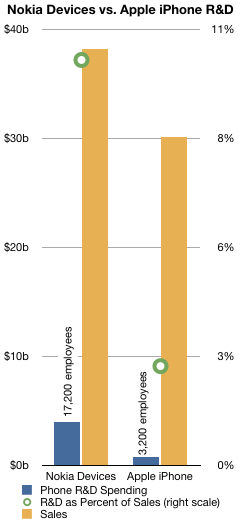
In a recent post I pointed out that Apple’s R&D was about 2.2% of sales in the last quarter. Bernstein took a look at the R&D for Nokia and presented a chart showing the difference between the mobile industry players in terms of total expenditure on R&D.

I took inspiration from that to plot the Devices R&D for both Nokia and Apple over the entire 2010 period. I also compared that with sales and computed the ratio between R&D and sales.

The result is shown in the chart on the left.

Bottom line: Nokia spent 10.2% of phone sales in 2010 on phone R&D while Apple spent 2.5%.

Bernstein goes on to argue that at least for Devices,

Nokia spent $3.9bn in R&D in 2010, almost 3x the average of its peers, 31% of the industry’s R&D total spending, for an output that we can qualify as visibly disappointing.

To relate the $3.9 billion for Devices into head count, they estimate that Symbian projects employ 6,200 people; MeeGo and Qt 1,800; Services 1,800; and S40 1,800. Hardware headcount is assumed to be 4,700 and 900 more for fundamental research.