Top Tags

Tag Nokia

Why OPK was fired

Under Kallasvuo Nokia embarked on the most dramatic shift in its business since entering the mobile phone business in the early 90s.

The shift was not into mobile software which began in 2001 under his predecessor. It was not into enterprise solutions which also preceded his tenure. OPK’s main contribution was the move into mobile services.

The concept of mobile services may be an unfamiliar one for casual observers because it has not become a visible business for operators and certainly not for handset vendors. It’s also a complicated business model that requires some deeper understanding of the way the telecom industry is structured.

What Nokia had in mind was to offer various value-added, billable services to operators which would be enabled by Nokia handsets. The types of services included music subscriptions (Comes With Music), email (several acquisitions), photo sharing, and navigation.

The idea was that since many operators would not be capable of rolling out own brand services and could not do the heavy back-end lifting or the integration with handsets, someone could step in and roll out white labeled solutions world-wide. Third parties would also find it impossible to integrate and would lack the relationships Nokia had with operators world-wide.

For example, Nokia could enable a South American operator to offer email services to all their customers (with or without smartphones) and that service could be offered at a certain incremental price over the basic voice plan. The client implementation could be device independent but Nokia devices would probably work better. This would lead to higher ARPU which could be shared with Nokia.

Anyone can see that this is a complicated business plan and is therefore unlikely to be successful. But what makes it a complete failure is the realization that most buyers will resist the idea of paying for individual services separately. $1/mo for email, $2/mo for music, $3/mo for maps, etc. is repulsive. Users stampeded instead to unlimited data plans and smartphones which offered all these services and hundreds more for free or at prices negotiated with third party providers, rather than the untrusted network operators.

And therein lies the entire cause of Nokia’s strategic failure: an operator centric point of view. It led to poisoned devices and irrational business plans.

Which leads to the question in the headline. Is this mistake recognized and is it big enough to cause such a disruptive CEO dismissal?

I argue yes. Strategic errors are forgivable, but the they become a capital offense when they turn into a derailment of the core business. Instead of being enhanced with value-added services, the core business collapsed under the disruptive attack of unlimited data.

But it gets worse. Like the capital offense that Robbie Bach was guilty of at Microsoft, there has to be some direct accountability. To add insult to injury, OPK single-handedly pushed through the biggest and stupidest acquisition in Nokia’s history. To support this flawed vision of mobile services OPK bought Navteq for $8.1 billion in October 2007.

Intended as a service that could be rolled out on all phones and monetized through operator billing, Nokia maps is a free service that will never return anything to shareholders.

Missing where the puck was going is one thing but burning precious capital is another. This, in my humble opinion, is why OPK was fired.

Speaking of pucks, here’s hoping fresh Canadian eyes will see where it’s going.

Nokia’s fifth last chance

The cellphone maker will unveil its new flagship model E7, which comes with a large touchscreen and full keyboard, at the show in London, two sources with direct knowledge of Nokia’s plans told Reuters.

via PREVIEW-Nokia bets on new smartphones for recovery | Reuters.

Analysts have been saying that Nokia has one last chance to fix (software, UI, strategy, etc.) for some time now.

Nokia sold 24 million smartphone units sold in Q2 which represented significant growth. Sales and Profits however were both down but to say that Nokia is facing imminent demise is misguided.

How is Nokia able to sell so many units when its portfolio elicits so much pathos?

The reason Nokia can still coast with poor products is that they have a vast distribution network. I don’t know the exact distribution but let’s assume that half their phones go through carriers and half through distributors who resell unlocked phones world-wide. Carriers will continue to carry the phones because they slot into well-established portfolio slots and distributors will continue to distribute because the product is competitive in markets where there are no other unlocked smartphones at the same price.

So predicting imminent failure without taking into account distribution inertia is showing a lack of understanding of the market. The same insensitivity to distribution is why so many predictions of Microsoft’s “death” or RIM’s “death” fail.

The less sensational but more accurate description of Nokia’s predicament is that their strength in distribution prevents them from reforming their business model in order to benefit from the disruption that mobile broadband is bringing to mobile telecommunications.

That’s a mouthful.

Apple devices take 41% of mobile traffic in Finland

In first half of 2010, iPhone and iPod touch traffic increased from 33.9% to 41% in Finland. Apple’s devices account for a very small percent of the total phones in use in Nokia’s home country.[1] The analysis was performed by QAim on a sample of 64 million “mobile downloads”.

Google Translate.

Original article in Finnish.

“A wave of iPhone and iPod owners behave differently than others.”

Weird bunch, those iPhone owners…

[1] Installed base of iPhone is small but share of smartphones in recent quarters is above 20%.  See: YLE: Nokia’s smartphone share crumbles in Finland

Bond market discounting Nokia’s credit rating

The world’s largest mobile-phone maker’s bonds are trading as if Nokia’s rating has been cut, with spreads over government debt widening as the company strives to develop devices with the same mass appeal as the iPhone, Research In Motion Ltd.’s BlackBerry and devices based on Google Inc.’s Android software.

There’s a “significant amount of risk overall with Nokia’s business model,” said Scott Shiffman, who directs bond research at Chapdelaine Credit Partners in New York. “Credit spreads should move wider over time and ratings will continue to move lower. We think the ratings agencies will play catch-up to the business deterioration.”

via Nokia’s Credit Rating in Jeopardy on Falling Profit, Bonds Show – Bloomberg.

Management response continues to be that Nokia is “by a very wide margin the largest supplier of smartphones and small computers in the world.”

The deterioration of Nokia’s core business

The saga of Nokia’s challenges has been well documented in this weblog.

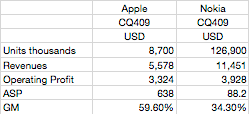
For this quarter, we take a look at the sequential deterioration in Nokia’s bottom line and draw causal inferences to its lack of competitiveness in mobile operating systems.

First, the bottom and top lines are shown below (in blue) and compared with Apple (in orange):

The charts show how Nokia’s bottom line (left) collapsed while the top line (right) remained relatively solid. By comparison, Apple remained consistent in revenue with slight dip in profit as it transitioned to a new model.

The top line (sales) is the product of units sold and their average selling price (ASP). Here are these two quantities side-by-side:

Note how Apple’s units are hard to discern relative to Nokia’s volume and how the opposite is true for the selling price. These values include all phones sold by the companies.

The story is a bit more clear when comparing the smartphone part of Nokia’s business, again with units and ASP:

The story here is telling: even in smartphones, Apple’s ASP is dramatically higher and much more resilient.

The question has to be why: Why can Apple retain not only higher prices (and hence margins)? The answer is competitiveness. Margin is an indication of value created and value differential is competitive differentiation. All the user satisfaction surveys, the reviews and tests boil down to these hard numbers above. The deterioration of Nokia’s business is directly traceable to its historic failure to embrace mobile software as a disruptive force and instead using it to sustain a hardware business.